
http://sanoj96.infinityfreeapp.com/wp-admin/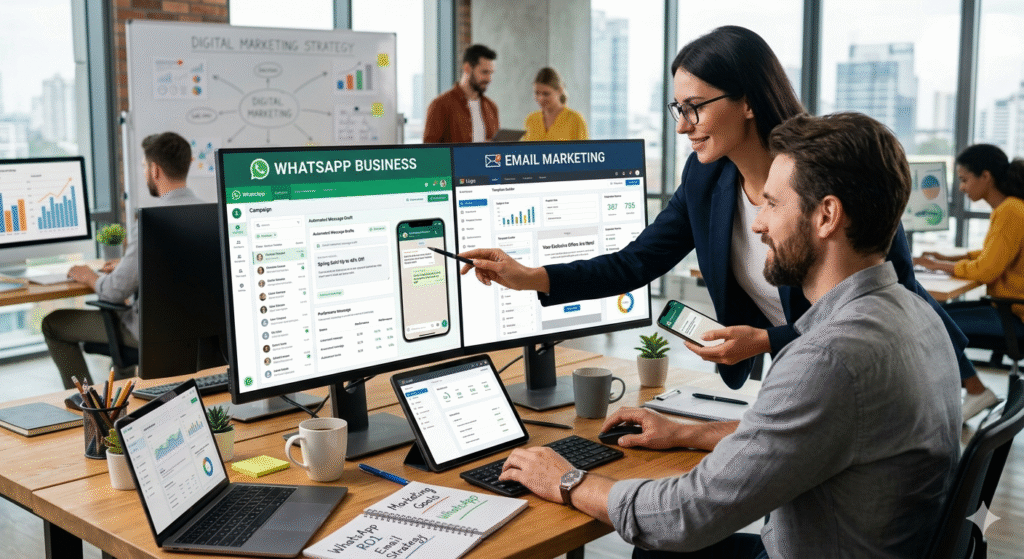
“WhatsApp vs Email Marketing: Key Differences”
WhatsApp Marketing vs Email Marketing
🌐 Section 1: The State of Digital Marketing in 2026
Digital marketing has never been more fragmented. Inboxes are crowded, ad costs are rising, and consumers are increasingly selective about where they give their attention. Two channels, however, have proven remarkably durable: email and WhatsApp messaging.
By the numbers in 2026:
There are 4.6 billion active email users worldwide — more than half the planet.
WhatsApp has crossed 3 billion monthly active users, making it the world’s most popular messaging app.
Mobile-first communication is no longer a trend — it is the default.
AI-powered personalization has raised customer expectations for relevance and timing.
📲 Section 2: WhatsApp Marketing — Reach Customers Where They Already Are
What Is WhatsApp Marketing?
WhatsApp marketing is the practice of using WhatsApp Business or the WhatsApp Business API to communicate with customers at scale. Unlike traditional SMS, WhatsApp supports rich media — images, videos, documents, voice messages, interactive buttons — all within a familiar, conversational interface that billions already use daily.
Why WhatsApp Marketing Works
WhatsApp marketing delivers results because it meets people where they already spend time. The average person checks WhatsApp dozens of times per day. A message that appears in their WhatsApp inbox carries far more immediate weight than an email sitting unread.
98% average open rate — virtually every message gets seen
45-60% click-through rate on interactive messages
Response times average under 90 seconds
End-to-end encryption builds trust with privacy-conscious consumers
No spam filters — messages reach the recipient directly
Best WhatsApp Marketing Tools & Strategies in 2026
Top WhatsApp Marketing Platforms
Wati — Best for SMBs, easy drag-and-drop bot builder
Interakt — Strong e-commerce integrations with Shopify, WooCommerce
Zoko — Advanced broadcast + team inbox management
Ai Sensy — AI-powered automation with CRM sync
Twilio / MessageBird — Enterprise-grade API flexibility
360dialog — Official Meta BSP, great for developers
Proven WhatsApp Marketing Strategies
1. Broadcast Campaigns: Send promotional messages, flash sales, and new arrivals to opted-in subscribers. Use approved message templates to ensure delivery.
2. Drip Sequences: Build automated follow-up flows triggered by user actions — cart abandonment, signup, or purchase.
3. Two-Way Conversations: Enable customers to reply, ask questions, and complete purchases without leaving WhatsApp.
4. Click-to-WhatsApp Ads: Run Facebook or Instagram ads that open a WhatsApp chat — a frictionless lead capture method.
5. WhatsApp Catalogs: Showcase products directly inside the app with image, price, and description — turning chat into a storefront.
WhatsApp Marketing: Limitations to Know
Requires opt-in — you cannot message anyone who hasn’t saved your number or initiated contact
Template messages must be pre-approved by Meta
Per-conversation pricing via BSPs can add up at scale
No native analytics dashboard — relies on BSP reporting
Not ideal for very long-form content or complex newsletters
📧 Section 3: Email Marketing — The Timeless Workhorse of Digital Growth
What Is Email Marketing?
Email marketing is the practice of sending targeted, scheduled messages to a list of subscribers via email. It is one of the oldest digital marketing channels, yet consistently delivers the highest ROI of any marketing channel — $36 to $42 for every $1 spent, according to industry benchmarks.
Why Email Marketing Still Dominates
No algorithm gatekeeping — you own your list
Unlimited content length and design flexibility
Advanced segmentation and A/B testing built into most platforms
Rich automation capabilities — welcome series, re-engagement, post-purchase
Works for every business type: B2B, B2C, SaaS, e-commerce, nonprofits
Deep analytics: open rates, click maps, revenue attribution
Email Marketing Best Strategies in 2026
Welcome Sequences:
The first 48 hours after signup see 4x the engagement. Automate a 3-5 email onboarding journey.
Segmentation: Segment by behavior, purchase history, location, and engagement level. Relevant emails get 6x higher transaction rates.
AI-Powered Send Times: Tools like Mailchimp and Klaviyo use machine learning to predict the best send time for each subscriber.
Re-Engagement Campaigns: Automatically target subscribers who haven’t opened in 60+ days with win-back offers.
Plain Text Emails: Sometimes the most personal-feeling email is a simple, no-design text message — especially for B2B outreach.
💳 Section 4: Mailchimp Pricing 2026 — Plans, Costs & Hidden Fees
Meta Title:
Mailchimp Pricing 2026: Plans, Costs & Hidden Fees
Mailchimp remains the most widely used email marketing platform in 2026. Here is an honest breakdown of its pricing structure — including the fees most review sites don’t mention.
Plan
Price/Month
Contacts
Best For
Free
$0
Up to 500
Beginners & solo creators
Essentials
From $13
Up to 50,000
Growing small businesses
Standard
From $20
Up to 100,000
Mid-size businesses
Premium
From $350
150,000+
Large enterprises
Mailchimp Hidden Fees to Watch Out For
Transactional emails (receipts, confirmations) require a separate Mandrill add-on — $20+/month
Removed contacts still count toward your billing period until the next cycle
Advanced automation and multivariate testing are locked to Standard and above
Phone support is only available on Premium ($350+/month)
Overage charges apply if your list exceeds plan limits mid-campaign
Pro Tip:
Mailchimp bills by total contacts, not active subscribers. Clean your list regularly to avoid paying for unengaged contacts. Tools like NeverBounce or ZeroBounce can help.
Mailchimp Alternatives Worth Considering
Klaviyo — Best for e-commerce, superior revenue attribution
ActiveCampaign — Advanced automation and CRM integration
Brevo (formerly Sendinblue) — More affordable for transactional volume
ConvertKit — Creator-focused, excellent for newsletters and courses
GetResponse — Good all-in-one with webinar tools
Section 5: WhatsApp vs Email Marketing — The Head-to-Head Comparison
Feature
WhatsApp Marketing
Email Marketing
Open Rate
98% avg open rate
20-25% avg open rate
Delivery Speed
Instant (seconds)
Minutes to hours
Message Length
Short, conversational
Long-form content OK
Rich Media
Images, video, voice
HTML templates, images
Audience Size
Best for <10K contacts
Unlimited scalability
Cost (Monthly)
$15-$500+ (BSP fees)
$0-$1,500+ (list size)
Spam Risk
Low (opt-in only)
High (spam filters)
Personalization
High (1-to-1 feel)
High (merge tags)
Analytics
Read receipts, replies
Opens, clicks, bounces
Automation
Limited flows
Advanced drip sequences
Best For
Conversational sales, support
Newsletters, nurturing
Regulation
WhatsApp Business Policy
GDPR, CAN-SPAM, CASL
When WhatsApp Marketing Wins
Flash sales and time-sensitive offers (open within minutes, not hours)
Cart abandonment recovery — conversational follow-up outperforms cold email
Customer support escalations — resolve issues in real time
Post-purchase engagement — delivery updates, review requests, upsells
Markets where WhatsApp penetration is very high: India, Brazil, UAE, Southeast Asia
When Email Marketing Wins
B2B lead nurturing — professionals check email more than WhatsApp for business
Long-form content: newsletters, case studies, product announcements
Large list management at low cost — email scales cheaply
Regulatory-heavy industries (finance, healthcare) where documentation matters
Re-engagement campaigns for dormant users who have blocked notifications
Section 6: ROI Analysis — Where Should Your Budget Go?
Here is a practical budget framework based on business type:
E-Commerce Businesses
60% email (newsletters, promotions, abandon cart sequences)
40% WhatsApp (order updates, flash sales, VIP customer club)
Service Businesses (Agencies, Consultants)
70% email (lead nurturing, case studies, proposals)
30% WhatsApp (client check-ins, appointment reminders)
Local / Retail Businesses
40% email (loyalty program, monthly offers)
60% WhatsApp (real-time deals, booking confirmations, community groups)
SaaS / Tech Companies
80% email (onboarding sequences, feature updates, re-engagement)
20% WhatsApp (trial expiry nudges, critical product alerts)
Section 7: The Smart Play — Using Both Together
The most effective marketers in 2026 treat WhatsApp and email not as competitors but as complementary layers of a single communication stack. Here is how to build that integration:
The Omnichannel Sequence: A Practical Example
Day 0 — Signup: Welcome email sent immediately with brand story and top offers.
>Day 1 — WhatsApp: Short greeting message with a single CTA — browse the catalog or book a call.
>Day 3 — Email: Educational content — how to get the most out of your product or service.
>Day 5 — WhatsApp: Personalized offer or limited-time discount.
>Day 7 — Email: Social proof — reviews, case studies, user-generated content.
>Day 10 — WhatsApp: Check-in message — ‘Any questions? We are here to help.’ Opens a two-way dialogue.
Tools That Connect Both Channels
HubSpot — CRM with native email + WhatsApp integration
Zapier / Make — Connect Mailchimp broadcasts to WhatsApp BSPs
Brevo — Built-in email + WhatsApp from a single dashboard
Salesforce Marketing Cloud — Enterprise-grade omnichannel
Wati + Klaviyo integration — Popular for D2C e-commerce brands
Section 8: Compliance & Legal — What You Must Know
Email Marketing Compliance
CAN-SPAM Act (USA): Include physical address, unsubscribe link in every email
GDPR (EU): Explicit consent required, right to erasure, data portability
CASL (Canada): Express consent required before sending commercial emails
CCPA (California): Consumers can opt out of data sale
WhatsApp Marketing Compliance
WhatsApp Business Policy:
Only message users who have opted in explicitly
Template messages must be pre-approved by Meta before sending
No unsolicited bulk messaging — accounts can be banned permanently
Respect opt-out requests immediately — failure leads to increased user blocks, which triggers BSP review
Section 9: The Verdict — Which Marketing Channel Wins in 2026?
After analyzing open rates, ROI benchmarks, scalability, cost, automation depth, and compliance requirements, here is the honest verdict:
Choose WhatsApp marketing as your primary channel if:
Your audience is highly active on WhatsApp (common in India, Middle East, Latin America, Southeast Asia)
You sell high-touch products where real-time communication closes deals
Your list size is under 50,000 and your conversion events are frequent
Choose email marketing as your primary channel if:
You are building a content-driven brand with newsletters, tutorials, or resources
Your business is B2B where professional communication norms apply
You need to scale to hundreds of thousands of contacts affordably
Use both channels together when:
You want to maximize touchpoints without overwhelming any single channel
Your customer journey spans multiple days or weeks
You can staff or automate responses across both channels effectively
Quick Reference Summary
Published 2026 | Keywords: mailchimp pricing, email marketing, whatsapp marketing, best whatsapp marketing,
whatsapp marketing and
email marketing
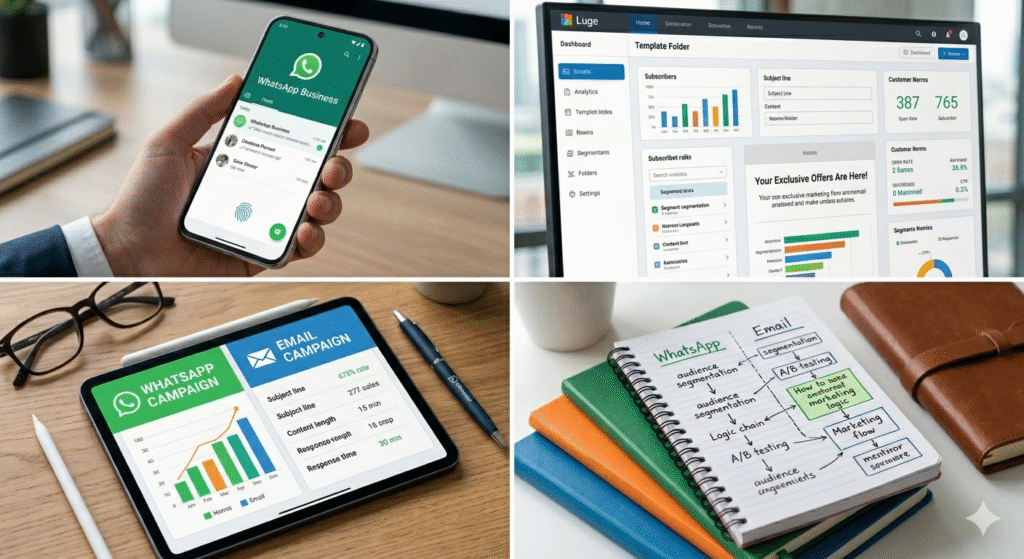
WhatsApp vs Email Marketing is one of the most discussed topics in digital marketing today. Businesses are constantly trying to decide which channel delivers better engagement, higher ROI, and stronger customer relationships.